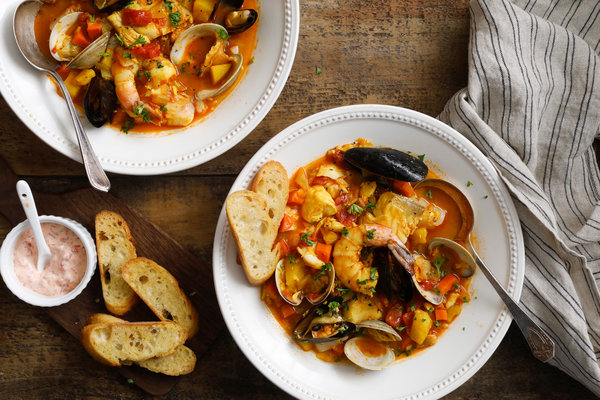
Exploring the idea of regional identity expressed through food, it is hard to look past the famous French bouillabaisse. Originating in the city of Marseille, in the Provence region, the renowned fish stew started as a poor-man’s meal made by the local fishermen, using the bony rockfish they were unable to sell. It usually consists of at least three types of fish, as well as a broth served with a rouille and croutons. Always eaten hot, this dinner dish is traditionally served in two separate dishes, one containing the fish and one the broth, and then combined onto one plate for consumption. This dish truly reflects the region’s identity as a fishermen’s port coming from humble beginnings and highlights the rich history of the people who once lived in the area, making do with what they had to create a hearty stew to feed the masses. This regional pride is still reflected today with the appearance of bouillabaisse on esteemed menus all over Provence and the connection to history that it creates. This dish highlights the concept of authenticity and the conflict between tradition and innovation, created with the introduction of new ingredients such as shellfish; a concept that is highlighted in our studies and more specifically, Ferguson’s Culinary Nationalism and Steinberger’s look at the adaptation of French cuisine in order to keep up with the ever-changing modern climate. Through the lens of this blog’s theme, one can see that bouillabaisse has travelled out of France through colonialism and migration, due to its simplicity and reliance on produce that is readily available in many of France’s colonies. This is further spread with the introduction of globalisation and can now be found at restaurants all around the world.
The history and travel of the acclaimed Bouillabaisse
 A Taste of Migration